Sunday, July 1, 2012

Artie Simek's post-Implosion work

One side-effect of reading comics for a long time is learning to recognize the distinctive styles of the people who created them. Some people are good at identifying artists and inkers, others (such as Martin O'Hearn) have learned to identify the specific tics and phrases of certain writers' dialogue, and there are those who can accurately determine who lettered a specific comics story.

Thanks to the efforts over the past decades of fans, historians, critics, and indexers it is now possible to google with a fair degree of accuracy the creative teams for a large part of the old comics one happens to find either as back issues, digital scans, or in reprint books. The enjoyment of reading a comic can be heightened by knowing more about who created it, at what stage during his/her career it was created, at what time period, for which publisher/shop/packager, etc. A run of the mill romance comic is more interesting if it's drawn by Alex Toth, we may be willing to read a funny animal story more closely when we know it was probably written by John Stanley, there may be hidden depths to that trashy-looking 1950's Charlton horror comic once we find out it was written by Superman's creator, Jerry Siegel, and so on.

Coming across these familiar styles and voices is pleasurable, and this can even extend to recognizing and enjoying the good, clear lettering practiced by craftsmen such as Ben Oda or Howard Ferguson. What was just a random comic story becomes part of a larger continuum of work, a glimpse into part of the history of a craftsman or artist who probably worked anonymously for most of his or her career. (One problem with this type of reasoning however, is that this can give you lots of excuses for not trimming your collection and throwing old comics away -- everything is potentially significant -- but that's material for another post.)

I became aware of the early (post-Fantastic FourMarvel superhero comics thanks to the 1970's Pocket Books editions along with reprint comics such as Marvel Tales. Most of the stories in these comics were lettered by Artie Simek and Sam Rosen, and it was easy to notice and learn these names since Stan Lee made a point of crediting them and at the same time making jokes at their expense in the credits (something that as a young reader I found amusing).

Artie Simek

Sam Rosen also worked for publishers such as Quality and Harvey, but practically all of Simek's career seems to have taken place at Timely/Atlas/Marvel Comics. Jerry Bails's Who's Who, for example, has him working from 1946 until his death in 1975 at Marvel, with no credits at other companies. (Simek's daughter Jean, also a comic-book letterer, passed away early this year.)

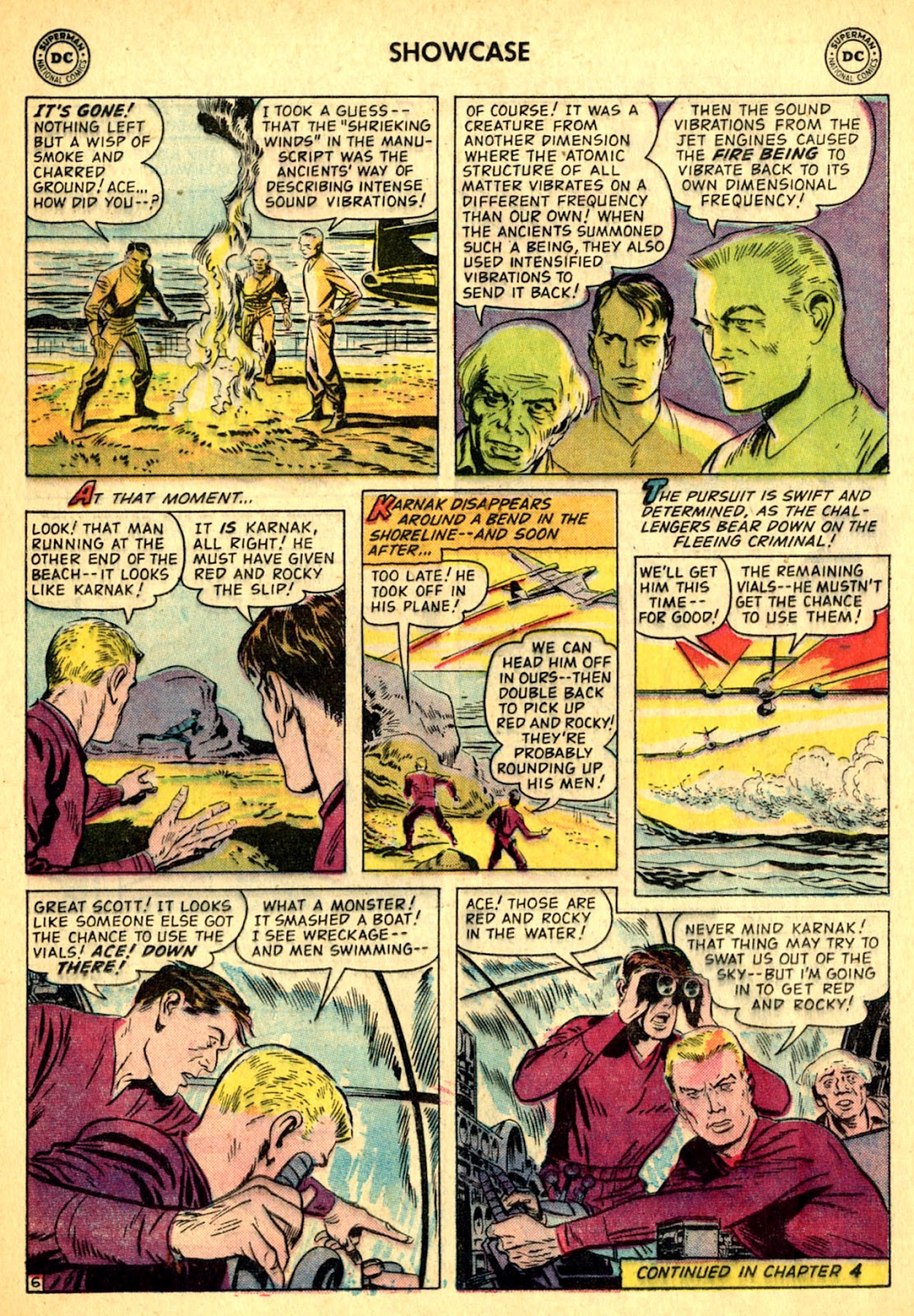
However, a few years ago I'd noticed that Simek's work had appeared in other comics. I first saw this in the Jack Kirby-drawn Challengers of the Unknown stories from Showcase #12 (cover dated February-March 1958, which means that the book appeared in late 1957).

"Challengers of the Unknown" splash from Showcase #12
The lettering in the above page is indisputably Simek's work, noticeable from the story's title's lettering to small details such as the highlighted first letters of the captions of the second and third panels.

Another Simek-lettered page from Showcase #12

When I shared this a few years ago over at the Grand Comics Database mailing list, fellow fan Marc Miyake pointed out that he'd also found Simek's work in a non-Marvel comic, this time in a story from Race for the Moon #2, from 1958.

Artie Simek lettering in another Jack Kirby story, "The Face on Mars"

Is the time period in these examples (late 1957 to 1958) significant? Most definitely. What is known as the "Atlas Implosion" took place in 1957, an event in which publisher Martin Goodman had to cancel several titles, fire staffers, and use inventory stories for a while (instead of assigning new work to freelancers). Many Atlas/Marvel freelancers and staffers had to find work elsewhere, and from what can be seen above, Artie Simek wasn't an exception.

Having found the above examples, it wasn't difficult to find other DC works by Simek from that period. Some examples are documented at the Grand Comics Database, others have been found thanks to the abundance of comics scans on the web.

Probably the earliest example (mentioned in Simek's Wikipedia entry) is the story "Batman's Roman Holiday" from Batman #112, cover dated December 1957.

Artie Simek lettering in Batman #112

House of Secrets #8, cover dated January-February 1958 has several stories lettered by Simek as well.

Art by Bill Ely, lettering by Artie Simek.

Art by Jack Kirby, lettering by Artie Simek.

Art by George Papp, lettering by Artie Simek.

And the story "The Truth about Love" from Heart Throbs #52 (cover dated February-March 1958) seems to also have been lettered by Simek.
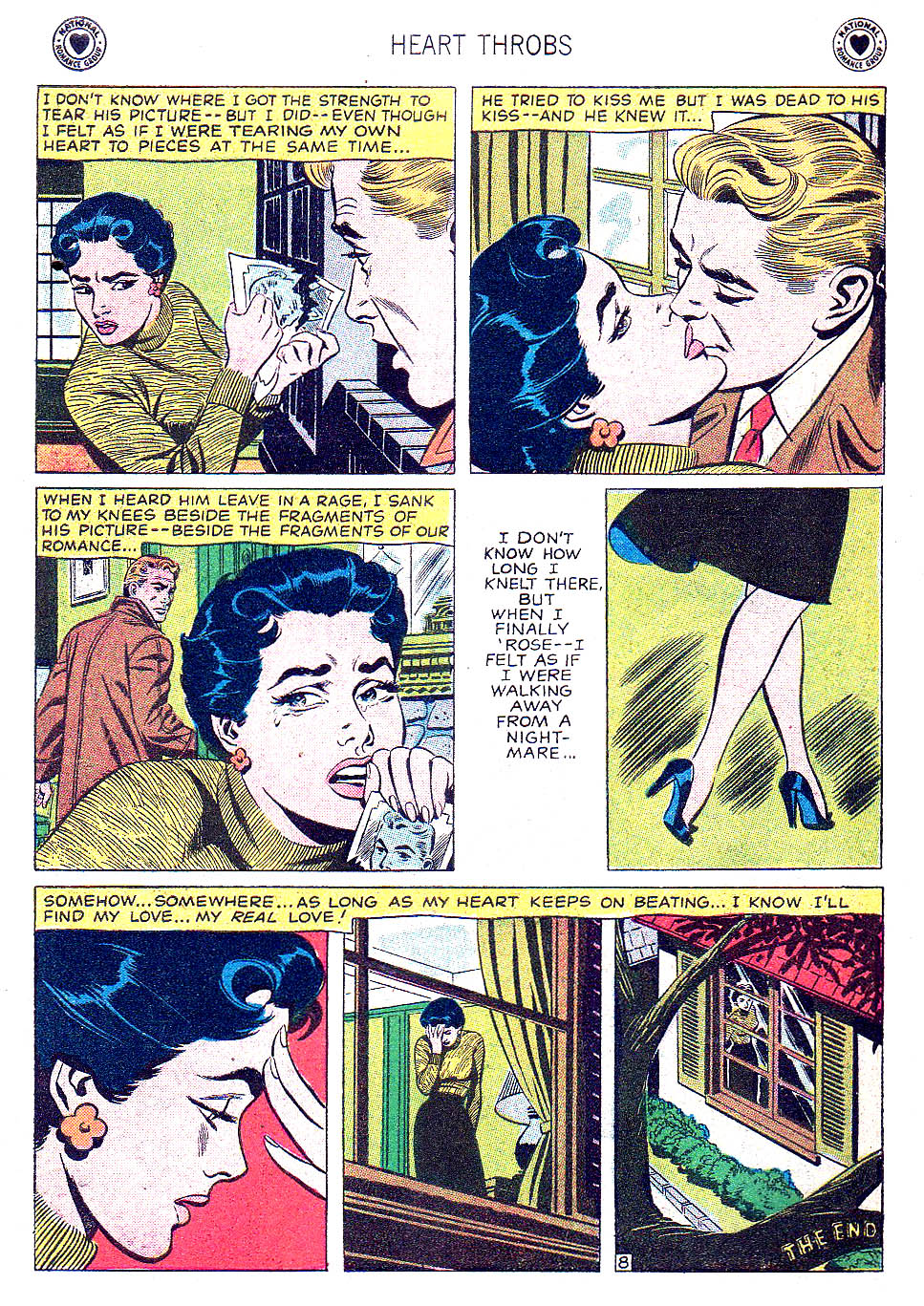
From Heart Throbs #52

Simek would eventually return to Marvel, and would become one of their main letterers during their 1960's expansion.

The effects of the Atlas Implosion were apparently felt across shores. Several years ago, Matt Gore pointed out the existence of little-known work done by Jack Kirby for the British market: a series of "Davy Crockett" stories that appeared as backups in Marvelman magazine. Matt has uploaded some samples from Marvelman #231, originally published in 1958. As far as can be told, the handful of stories Kirby did for Marvelman were never published in the United States.

Jack Kirby art from Marvelman #231

I'd seen these pages back when Matt Gore originally shared them, but seeing them again today made me notice for the first time that they were also lettered by Artie Simek.

I don't know much about the origin of these stories or how they ended up appearing in a British publication. Richard Bensam pointed out to me via Twitter that Kirby had drawn stories featuring Davy Crockett and Jim Bowie between 1955 and 1956, in issues 31 to 33 of Harvey's Western Tales. Are these stories from Marvelman part of the same series? Or could these be unused Atlas inventory stories (which would explain the Simek lettering)? I wrote at the beginning of this post about how easy it is these days to google information about old comics and their creators, but there's clearly still much more to be learned about them, even about the work of well-known figures like Jack Kirby.

Thursday, May 3, 2012

Obituaries: Belford A. Richards & Norman Fruman

Two recent obituaries of persons who worked in North American comics.

From D.D. Degg comes news of the passing of Belford A. Richards, who apparently wrote the Wash Tubbs/Captain Easy comic strip during the early 1950's, when Leslie Turner was drawing it.

Captain Easy Sunday page for March 15 1953, drawn by Leslie Turner.


ANDOVER - Belford Arlington Richards, 86, died Sunday, April 29, 2012, at Franklin Regional Hospital. 
He was born in South Portland, Maine, on April 25, 1926, the son of Harold Scott Richards and Aria Gould Richards. 
He graduated from St. Paul's School in Concord, in 1945. 
Joining the U.S. Marine Corps at 18 years old, Belford was one of the youngest Marines to serve during the end of World War II over the South Pacific as an aircraft radar/radio operator and tail gunner. 
He attended the University of MI and transferred to Rollins College, Fla., where he graduated in 1953 with a BA. 
While at Rollins College he wrote comic strip continuity for Les Turner, artist of the Washtub [sic] Comic Strip cartoon. Mr. Richards traveled to England in the 1950s to do research on a book he was writing called "Forty on the Emu." He returned to Portland, Maine, in 1963 and was employed in advertising and became a Freemason. In 1974, he moved to Bradford, and had resided in Andover for the past 15 years. Mr. Richards was an avid reader, collector of original comic strip art, and loved to travel, especially to the island of Gozo, Malta. He leaves behind Gail Gurnsey Richards, his wife of 25 years; two sons, Tyler Ford Richards and the Rev. Michael H. Richards; a daughter, Lizabeth McAllaster Tompkins and numerous friends in both Europe and the U.S.

And from various sources comes news of the passing of University of Minnesota professor Norman Fruman (like Richards, another World War II veteran). From the Star-Tribune's obituary:


Norman Fruman, a noted scholar and a longtime faculty member of the Department of English at the University of Minnesota, died of cancer on April 19 at his home in Laguna Beach, Calif. He was 88. 
Fruman is perhaps best known for his 1971 book, "Coleridge, the Damaged Archangel," which exposed a pattern of plagiarism by beloved English poet and literary critic Samuel Taylor Coleridge.


Cover to Adventures into the Unknown #53 (March 1954). Art by Harry Lazarus.


According to Jerry Bails's Who's Who, Fruman was an assistant editor for ACG between 1951 and 1955, where he also wrote stories for titles such as Adventures into the Unknown. He's also credited with having written "about 700 scripts" for Better Publications during that decade.

Sunday, March 11, 2012

Two Moebius interviews (1977 & 1982)

Here's a Jean GiraudMoebius interview conducted in November 1977, and published in the first issue of Graphixus (1978) and later in Alter Ego #11 (1978). The accompanying text in the latter publication states that the interview was conducted by Mal Burns (publisher of Graphixus), Dominique Gaillard, and Mike Friedrich.

At the time of the interview, Metal Hurlant magazine was only a couple years old, the English-language version, Heavy Metal, was only a few months, and Moebius's first collaboration with Alejandro Jodorowsky, Les Yeux du Chat, had yet to appear.

The scans are from my copy of Graphixus:


"I put many things into a story -- subconscious things that I can't always see immediately myself. When I do a story, I really suffer! I try to do, say eight pages and I put all my feelings towards it inside it, but at the same time try not to put a message into it because I know that the basic message is the story itself. It's rather like hitting that exact magic note when playing music, so for this reason I don't try to be intellectually very strong -- but more try to be in harmony."


"I can actually see something changing in the new pages of Blueberry, but I'm unclear as to exactly what. Maybe in two years I will look back at it and see what, but right now I'm too involved with it."

(The date of the interview suggests that Giraud is talking here about Nez Cassé, the 18th Blueberry album, identified by Dave Gibbons as his favorite Moebius work: "perfect fusion of Giraud and Moebius.")


And here's a brief 1982 interview with Moebius about his work on Tron:


Also recommended: a 35-minute Moebius interview (with subtitles in English) found at Fascineshion.

Saturday, March 3, 2012

Comic Con India videos: Robert Crumb, Gary Groth, and Chris Oliveros

More from Comic Con India, the videos for presentations given by cartoonist Robert Crumb, Fantagraphics publisher Gary Groth, and Drawn & Quarterly publisher Chris Oliveros have been uploaded.

(Hat tip to Mike Lynch, who featured the first Crumb video at his blog.)


Robert Crumb in conversation with Gary Groth, February 19, 2012 (4 parts):


Comic Con India Special Session with Gary Groth: Co-Founder, Fantagraphics, February 18, 2012 (3 parts):


Comic Con India Special Session With Chris Oliveros, Founder, Drawn & Quarterly, February 17, 2012 (2 parts):


Sunday, February 26, 2012

Bret Easton Ellis: The Warren Years

It is in some ways an homage to Stephen King and the comics I loved as a kid. Especially the EC Comics, like Vault of Horror and Tales from the Crypt. And the Warren Comics of the '70s that I was a huge fan of. They had titles like Creepy and Eerie and Vamperilla [sic]. These were all influences on Lunar Park. That was the impetus to write the book. To write a book that was similar to the books that gave me pleasure as a boy and as an adolescent. I was really into the horror genre and the supernatural genre when I was a teenager and certainly I came of age, along with a lot of men of my generation, with the first book that Stephen King published and onward.

-From an Amazon.com interview with Bret Easton Ellis, about the influences behind his novel Lunar Park.

What follow are letters published in Warren magazines during the 1970's, written by Ellis when he was between 12 and 14 years old, along with samples of the stories he commented on at the time. Click on the scans to see at large size.

From Creepy #84, cover-dated November 1976.

Ken Kelly's cover to Creepy #81
Splash page to "Battle Rot", by Bill DuBay and John Severin.
Another page from "Battle Rot"


From Creepy #96, cover-dated March 1978.
Splash page to "Ada", by Bill Pearson and Alfredo Alcalá
First page of "Sacrifice", by Roger McKenzie and Luis Bermejo
Another page from "Sacrifice"
More from "Sacrifice". Probably a coincidence, but the tied girl reminded of a sequence from Ellis's Less Than Zero.

From Creepy #99, cover-dated July 1978.
Splash page to "Black Death" ("one of the best stories ever to appear in a Warren magazine"), by Bruce Jones and Leopoldo Sánchez
Another page from "Black Death"


From Creepy #100, cover-dated August 1978
Splash page to "Helen Horror Hollywood" by Gerry Boudreau and Leopoldo Durañona

The above were all the "Bret Ellis" (Sherman Oaks, CA) letters I could find, after an exhaustive search through scans of CreepyEerieVampirella, and other Warren titles. There's still a slight chance more Ellis letters were published, though, in case anyone wants to keep on looking.

Sunday, February 19, 2012

Robert Crumb in India

Robert Crumb is a guest at Comic Con India, and there's been some local coverage:

"Keep on Truckin'" (Tehelka):

Why is the trope used in graphic novels, especially in the West, autobiographical in nature? 
RC: That’s an interesting question and I really don’t know the true answer. Growing up in the 60s, there was this tremendous temptation to be liberal with your expression. It was also about asserting your identity, whether it was ethnic or cultural or artistic. A lot of us felt that there was a story everyone could relate to, even though it was about our personal lives…

"Comically Contentious" (The Indian Express):
One of Crumb’s most popular characters, Mr. Natural, a “self-described” ascetic guru and voluptuary, is said to be partly a caricature of Maharishi Mahesh Yogi. While Crumb says Mr. Natural wasn’t based on one person, there are certain influences of Indian mysticism. He said, “In the ’60s and ’70s, we were influenced by movements such as Hare Krishna etc. I used to read a lot of Yogananda, Mahesh Yogi and others, and some of it manifested in Mr. Natural.”


"A Slice of Crumb" (Hindustan Times):
“I’m here just to see the country. I don’t come to comic conferences,” Crumb paradoxically started off.

Wednesday, February 1, 2012

J. Michael Straczynski on Alan Moore and reinterpretations (2006)

Six years ago, years before anyone thought that adding a "TM" mark to "Crimson Corsair" was a good idea and back when projects like Before Watchmen were mentioned only in April Fools' Day posts, the big Alan Moore-related controversy in comics circles was his decision to distance himself from the V for Vendetta movie adaptation and Hollywood in general. The decision (which included transferring his film royalties to the artists involved and the removal of Moore's name from the film's credits) was drastic, but the reasons Moore gave made sense.

(He was tired after having been cross-examined for ten hours because of a screenwriter's claim that League of Extraordinary Gentleman had been plagiarized, and the last straw was seeing Warner issue a press release in which produced Joel Silver falsely claimed that Alan Moore would be involved with the V for Vendetta film. Moore tried vainly to get an apology or retraction.)

A few weeks after this, there was an interesting discussion over at the Newsarama message boards between Don Murphy and Rich Johnston about this same subject. The thread, which featured posts from creators such as Eddie Campbell and J. Michael Straczynski, is unfortunately no longer online, but I was able to find a backup I made at the time.

One of the comments that caught my attention at the time was Straczynski's. There was a part of it that I found incredibly condescending, and I was reminded of it after seeing his interviews today. Quoting Straczynski (emphasis in bold is mine):

Alan has banked his whole world-view on the notion that film and TV folks will always screw up his work, that they're all hacks or the like. And in some cases, he may have some legitimate beef. But in other cases, as with Vendetta, which was and is a very, very good movie, I think it almost threatens his world-view. He reacts with even more anger because the cognitive dissonance is just too much, the idea that Hollywood could do a good job on one of his books is more than he can or chooses to handle. And so he lashes out.

What Straczynski seems to be saying here is that the reason Moore doesn't care for adaptations of his work is because Moore is secretly afraid that someone will do a better work. It's an amazingly arrogant and pig-headed statement to make (it's one thing to say that Moore is wrong or that you don't agree with him, it's a whole different thing to pretend to get into his mind and make up reasons for why Moore acts as he does), but it helps explain the mentality of one of the writers responsible for two of the upcoming Before Watchmen mini-series (and who coincidentally is the creator which has been the most outspoken about this new work and why Moore has lost the "moral high ground").

Straczynski's full Newsarama comment (in which he also trivializes Moore's reasons for distancing himself from Hollywood, and in which he, more reasonably, explains why he believes art should be re-interpreted with the passing of time) is reproduced below, in order to provide context for the quote above.


Re: V FOR VENDETTA: THE UNSTOPPABLE TRADE
straczynski
Junior Member
Registered: Nov 2004
Location: Just some town
Posts: 13 
from jms  
Don -- 
Having fought more than my own share of battles for quality with the studios and networks, I've long sympathized with Alan at his end of things. And let me be clear: I think he's the best writer in the business, bar none. I've collected, and read, the majority of what he's written. He's an amazing, amazing talent. 
But I think that in regards to some of the movie stuff, he's gone way off the beacon. 
This is particularly true of his comments regarding V for Vendetta. As it happens, I know the Wachowskis, I consider them good friends and most of all hard-working, dilligent writer-producers who went as far afield as anyone could imagine to be faithful in rendering their adaptation of his story. I was blown away by the script, and said so publicly at the time that I read it. 
And then Alan went on the rampage about it, but when the proverbial push came to the equally proverbial shove, he was only able to cite a few things like mis-statements regarding the British postal service, and the names of a few things, as the source of his rage...a rage that was substantially greater than anything he'd said before about anything else. 
I've been watching this situation for some time now, and I have a thought or two about what might actually be going on...because as anyone who's ever had an argument with a loved one or friend knows, sometimes the argument's not really about the argument, it's about something else. 
Alan has banked his whole world-view on the notion that film and TV folks will always screw up his work, that they're all hacks or the like. And in some cases, he may have some legitimate beef. But in other cases, as with Vendetta, which was and is a very, very good movie, I think it almost threatens his world-view. He reacts with even more anger because the cognitive dissonance is just too much, the idea that Hollywood could do a good job on one of his books is more than he can or chooses to handle. And so he lashes out. 
Anyone who has ever had to interpret a given work and translate it into another venue knows that change is inevitable, especially because what makes literature work is internal and film/tv are external media. I've adapted Jekyll and Hyde for Showtime, I just finished adapting Watchbird for ABC's Masters of Science Fiction, and there were necessary changes...but the core of the story works, is still there, as it is in Vendetta and elsewhere. 
Finally, and perhaps most to the point, art is supposed to be interpreted and re-interpreted with the passing of time. That's what it's FOR. So that each generation gets a new look at it. I've seen Shakespeare's "Two Gentlemen of Verona" produced in a World War One venue, seen the filmed version of "Richard III" set in a neo-fascist England, saw on stage "Hamlet" played with a female in the lead...the greater the masterpiece, the more it lends itself to interpretation and re-interpretation. 
That's what the Wachowski's did with Vendetta: they didn't leave it written in stone, they brough [sic] to the discussion, to the adaptation, today's political and social climate and thus made something that was timely in its day just as timely today. If the story is about the world and repression, if the shape of that world changes, then how can the story not change to match? Otherwise it runs the risk of becoming irrelevant.
I'm a huge Alan Moore fan, always have been, always will be. He is, again, the best of us.  
But on this count, he is wrong. And he needs to reconsider.
jms

Last edited by straczynski on 04-04-2006 at 10:32 AM
04-04-2006 10:19 AM